

It has been a little over an year since I pitched Kaspi back in June 2024. The company listed on NASDAQ only in January 2024, and was relatively an unknown fintech operating out of Kazakhstan, a country that most of us still struggle to spell correctly. To a large extent, I think it is still an under the radar stock but not as obscure as it was an year back. Some of us who covered it back then realized it is similar to Tencent. Now there are lot more substacks covering this stock. Since I pitched the deal has gotten much sweeter (Stock is down 33%), growth is de-risked (Expanding TAM) and the valuation much cheaper than earlier (7 times earnings).
While Kaspi’s core business continues its momentum, they recently set their sights on Turkey
The new chapter on Kaspi’s story is their recent acquisitions in Turkey -Hepsiburada and Turkish subsidiary of Rabobank A/S. Kaspi paid around $1.1B to acquire 65% of Turkish e-commerce player Hepsiburada.
Hepsiburada was purchased at 0.75 times FY25 annualized revenue which included a net-cash of $200M. That does not strike me as expensive. The company has 12M active customers and is the second biggest e-commerce player after Trendyol. There is also Amazon which entered Turkey in late 2018. Certain unverified sources put Trendyol at 35% market share and Hepsi at 18% and Amazon Turkey at a distant with only 6%.
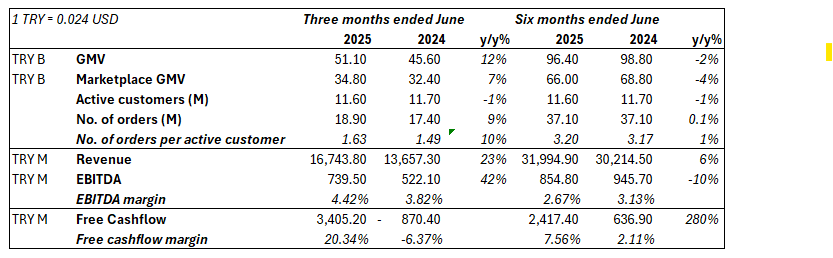
They have around 11.6M active customers and number of orders have roughly stayed flat in 6 months in 2025 vs 2024. Marketplace is around 68% of total GMV. Very similar to Kaspi’s setup back home.
Hepsiburada was started by Dogan Boyner, daughter of a billionaire family who owns one of Turkey’s leading newspaper - Hurriyet. Started in 2004, Hepsiburada translates to Everything is here. They are the Amazon of Turkey. Initially started selling electronics as a 1PL player, Hepsiburada now does more than 65% of their sales via their 3PL marketplace and across multiple categories. (Excellent piece on Hepsiburada origin story here by Forbes)
This does beg the question - Why did they sell?
There is no direct source here that tells us why Dogan Boyner decided to sell. However I could come up with two possibilities:
Possibility 1: Dogan family has been selling assets after issues with government
Dogan has been selling their media assets over the last few years. Hurriyet is their crown jewel which was sold in 2018. The buyer was a pro-Erdogan unlisted company. Their magazine group was sold in 2016 for $10M. The government in 2019 had levied a fine $4.5B in unpaid taxes but this was largely seen as a politically motivated move. In the same vein, they probably decided to exit their e-commerce business as quickly as they could.
Possibility 2: Hepsiburada stock has lost around 75% of its value since listing - Her father’s paper net worth coming down resulted in a quick fire-sale
Hepsiburada listed on NASDAQ in 2022 at a share price of $15 per share, for $3.9B valuation. Given the macro headwinds around Turkey (hyper inflation, currency devaluation), the share price quickly sold off to $2.8 per share for a market cap of $880M. Perhaps this was a good time to exit?
Quick note on Rabobank acquisition
Rabobank A/S’s Turkish subsidiary is barely a bank. It is basically a banking license that Kaspi acquired. They have no loans, no deposits and barely 30 employees. (Still not sure what those employees do). The top 5 banks in Turkey has 70% of the country’s total deposits and 3 of the top 5 are state owned. For now, Kaspi leadership has not done much with this banking license.
Conclusion - Kaspi’s Turkey arc
Given what we know so far, if I am clear about one thing that is Kaspi is looking to recreate their SuperApp magic in Turkey. The country’s banking structures are ancient, ripe for disruption. The e-commerce space is led by Trendyol but their focus is largely on clothing. Probably Lomtadze is seeing the white space to capture - a superapp that ties together banking, high-frequency e-commerce purchases and payments bundled together.
This is going to be harder said than done. Kaspi has suspended dividends and buybacks as they focus on international expansion. They are venturing into tricky countries with cloudy macroeconomics with bold and cheap acquisitions. But I think it is not the worst idea to give this management some time to prove how this pans out. The downside is limited as far as they don’t pump extra capital into this. They have not taken debt or issued shares for this acquisition. Kaspi makes more in a year than what they paid for Hepsiburada.
Kaspi is turning out to be a story of patience. I don’t think it is as undiscovered as it was before. But the macro surrounding it probably scares away most investors ignoring the business
Kazakhstan Tenge depreciated against US dollar by 21% since 2022. Kazakhstan shares almost its entire northern border with Russia. Initially I had bet that the instability would come to an end soon and with that the investor sentiment about that region would improve. But those timelines would have to be readjusted. Many believe the country lies at significant risk at getting into Russia’s crosshairs. However the Russians sanctions still continue and with that the sentiment around Kaspi continues to be bearish. The stock trades like a deep-value illiquid OTC stock, trading around $26M average per day over last 3 months compared to a market cap of $15B. Insiders continue to own 59% of the stock which makes it hard for an institution to take a significant position.
The catalyst might come sooner than you think
Most credit rating agencies were lukewarm even with their Hepsiburada acquisition but that is changing. In the recent past, many have upgraded both Kaspi’s and Kazakhstan credit outlook.
S&P: upgraded Kaspi Bank’s rating to BB+ (June 26, 2024) on improved metrics.
Fitch: assigned Kaspi an investment-grade rating (BBB- with stable outlook) in H2-2024.
Moody’s: assigned Kaspi an investment-grade Baa3 (stable) in early March 2025 — this, together with Fitch, allowed Kaspi to access a broader international bond investor base and price the $650m bond successfully.
But the share price is not reflecting any of that. For now, I am happy that Lomtadze still owns significant amount of stock but equally concerned that inside ownership can be a double edged sword. I have not increased my position (still sub 2% of my portfolio) and I have not sold either.
Thanks for the article! Kaspi is a large chunk of my portfolio too. What bothers me is that Baring (PE fund who has owned it for years) has been selling, according to public disclosures. Do you have a view on this?
To be honest at these levels management needs to announce share buybacks in the next earnings or latest for FY2025 earnings. It is really a shame that they didn't keep any of it alive, at these levels it seems too cheap to be true, even at no growth it represents a double digit return over the next years.